
AI Mastermind
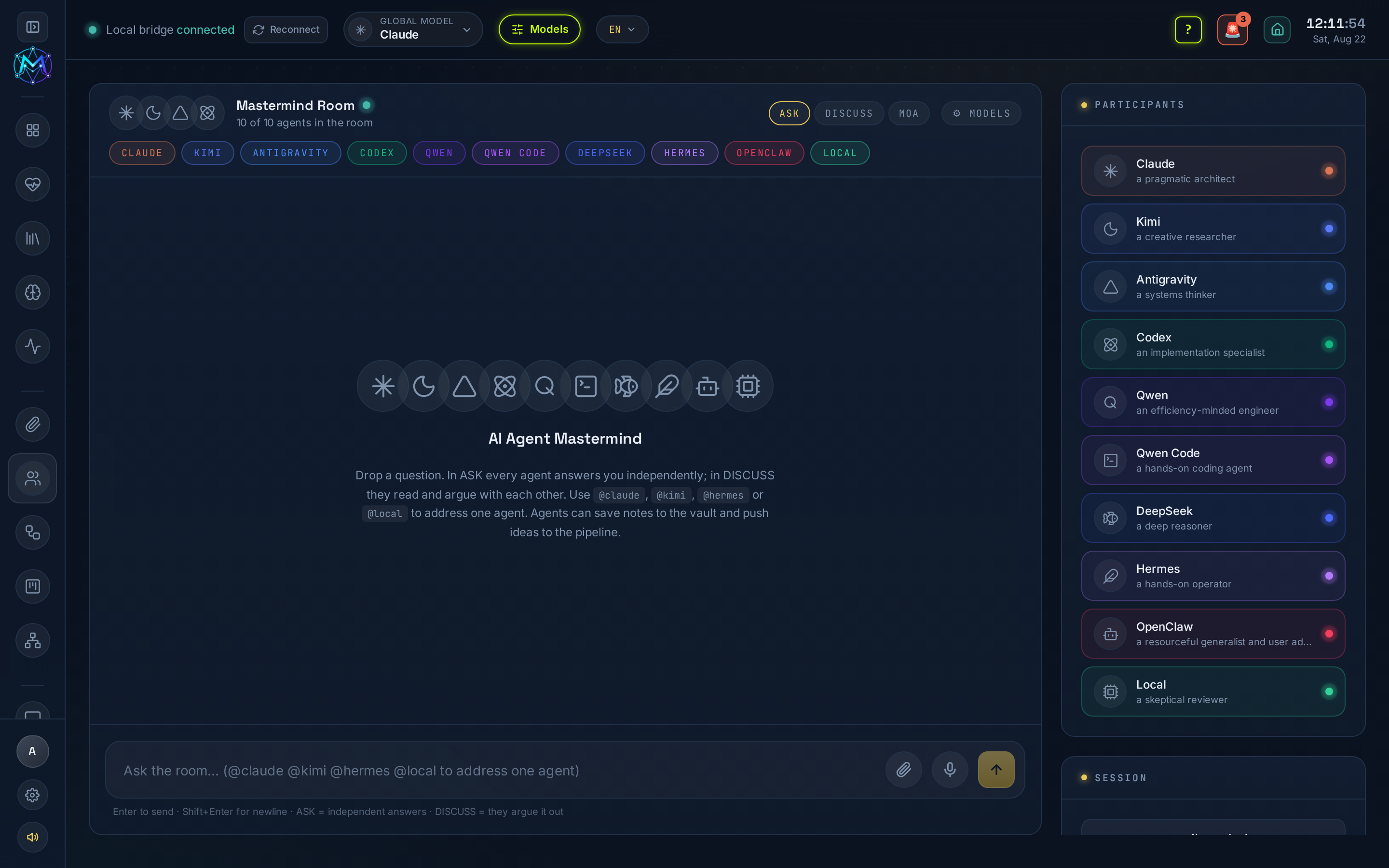
The AI Mastermind is a multi-agent group chat, at /room.
What it does
Section titled “What it does”Runs up to 9 agents - Claude, Kimi, Antigravity, Codex, Qwen, DeepSeek, Hermes, OpenClaw, Local - against the same prompt, replying in turn and riffing on each other. Agent chips show live availability (offline agents render dashed with a ○); only reachable agents are selected by default. Use @claude-style mentions to address one agent directly.
The chips next to ⚙ Models switch the interaction mode:
- ASK (default) - every agent answers you, independently. They cannot see each other’s replies, so you get N honest, uncontaminated takes on the same question. Best for “what do you all think?” and for comparing models.
- DISCUSS - a round-table. Each agent reads everything said so far and is told to engage: name the others, say where it agrees or disagrees and why, build on or push back, and surface what was missed. Pick 1-4 rounds (
×N) - every extra round is another full pass over all agents. - MoA (mixture-of-agents) - converges many answers into one. It runs in layers (choose 1-3, default 2): in the first layer every chosen agent answers independently; in each next layer every agent sees all of the previous layer’s answers as an anonymous, numbered reference set (anonymised on purpose, so a small model judges the content, not the brand) and refines. A final aggregator - one of your chosen agents - synthesises the last layer into a single answer. Failed answers are dropped from the reference set.
All three modes keep the same guard: agents answer the actual question and do not invent projects or pipelines around a casual one.
MoA cost, shown before you run
Section titled “MoA cost, shown before you run”MoA is the expensive mode, so it estimates the spend before you commit and shows it as a live chip:
- Calls =
agents × layers + 1(the+ 1is the single synthesis pass). - Level -
ok(≤ 12 calls),heavy(> 12),extreme(≥ 18), coloured muted / amber / red. - A cheaper hint suggests a smaller
agents × layerswhen the bill runs high.
Nothing is blocked - the chip only warns. At run start the room echoes it, e.g. MoA · 2×4 + 1 = 9 calls.
Per-agent models and thinking
Section titled “Per-agent models and thinking”Click ⚙ Models in the header to pick the exact model each agent runs and toggle thinking on/off per agent. Choices persist in ~/.maven/settings.json → roomAgents.
| Agent | Models offered | Thinking toggle |
|---|---|---|
| Claude | Opus 4.8 / Sonnet 5 / Haiku 4.5 / Fable 5 | - |
| Kimi | K2.6, K2.5, K2.7 Code (±Highspeed), Moonshot v1 8k/32k/128k + live extras | ✓ (K2.5/K2.6) |
| Antigravity | live from agy models (Gemini 3.5 Flash / 3.1 Pro / Claude 4.6 / GPT-OSS) |
- |
| Codex | GPT-5 Codex, GPT-5, o3, o4-mini, GPT-4.1 | ✓ (reasoning effort) |
| Qwen / DeepSeek / Local | installed Ollama models | ✓ |
| Hermes / OpenClaw | CLI default | OpenClaw ✓ |
Kill switch
Section titled “Kill switch”While a round runs, a red Kill switch button replaces Send. It cancels the server-side job first (what actually stops the agents and the token burn) and only then drops the stream. It is checked before every agent and before every round, so nothing new starts; the one agent already mid-call finishes that single call - it cannot be interrupted once running - but the cascade stops immediately.
Where the history goes
Section titled “Where the history goes”Every conversation is stored twice: as JSON in <vault>/room/ (what the History panel reads) and as a readable Obsidian note in <vault>/AI Mastermind/ASK/ or <vault>/AI Mastermind/DISCUSS/, named YYYY-MM-DD - <title> (<id>).md. The note carries YAML properties (mode, date, participants, messages) so you can filter and link them in Obsidian, followed by the full transcript. Deleting a chat in M.A.V.E.N deletes its note too.
Needs whichever agents you want participating installed and reachable - offline agents are simply deselected. OpenClaw additionally needs a one-time openclaw agents add main to give its embedded agent a provider key. See the dependency table in README.md for what each agent requires (Claude Code CLI, KIMI_API_KEY, agy, codex, Ollama, hermes, openclaw).
- Buttons in the room let you save notes to the vault and push ideas to the Pipeline.
- Use ASK to compare models on one question; use DISCUSS when you want the agents to critique each other.